Top questions
What does Kenyanthropus platyops mean?
Kenyanthropus means 'Kenya man', and platyops means 'flat face'. The name was given in 2001 by Meave Leakey and her colleagues to a skull whose face is flatter and more upright than the faces of most early human relatives of its time.
Who found the Kenyanthropus skull?
Justus Erus, a member of Meave Leakey's team from the National Museums of Kenya, found the skull at Lomekwi, west of Lake Turkana, in 1999. It was catalogued KNM-WT 40000.
Is Kenyanthropus a real species?
That is disputed. The skull is badly crushed and distorted, and critics, notably Tim White, argue that its flat face is the result of that damage, and that it is simply a member of Australopithecus afarensis. Its discoverers say the distortion is limited and that its features are real.
Did Kenyanthropus make stone tools?
Maybe. Stone tools about 3.3 million years old were found at Lomekwi 3, within a few kilometres of the skull's discovery site, and reported in 2015. They are older than the earliest Homo. Nobody knows who made them. Kenyanthropus is one candidate, as is Australopithecus afarensis.
How old is it?
About 3.5 million years, based on dating of volcanic ash layers above and below the fossil site. That is about the same age as Lucy's species, and it shows that more than one kind of early human relative was living in East Africa at that time.
The species in brief
Kenyanthropus platyops, the “flat-faced man of Kenya”, is one of the most disputed names in human evolution. It rests mainly on one skull, found in 1999 near Lake Turkana, that has a flatter, more upright face than Australopithecus afarensis, which lived in the same part of Africa at the same time. If it is a separate species, it shows that by about 3.5 million years ago the human family tree already had several branches. If it is not, the skull is just an unusual and damaged afarensis.
Discovery
In August 1999, at Lomekwi, a site west of Lake Turkana in northern Kenya, a member of the team led by Meave Leakey of the National Museums of Kenya, Justus Erus, spotted a skull in the dry gully. It was crushed and cracked, with the face pushed to one side, but much of it was there. It is catalogued KNM-WT 40000 (Kenya National Museum, West Turkana). A lower jaw fragment, some teeth and a few other pieces were also found nearby.
Meave Leakey, with Fred Spoor, Frank Brown and others, published the find in Nature in March 2001 and gave it a new genus as well as a new species: Kenyanthropus platyops. Her argument was that the combination of a flat face and relatively small molar teeth was unlike anything else of that age.
The Leakeys have worked on early human origins in Kenya for three generations. See the Koobi Fora page for the wider Lake Turkana story.
What the skull looks like
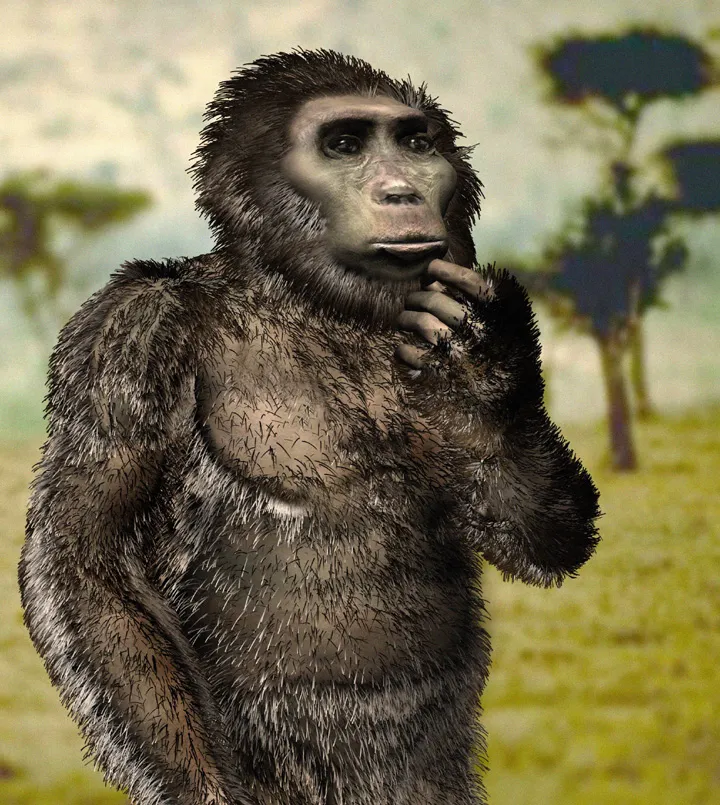
- Face. Flat from the side, with a short, upright face under the braincase. Most early human relatives had faces that jutted forward like a muzzle, with a sloping profile.
- Cheek teeth. Smaller than in afarensis and in the robust Paranthropus species.
- Braincase. Small, in the range of other australopiths, an estimated 400 to 500 cubic centimetres, though the damage makes this uncertain.
- Overall. A mix of old and newer features. The cheek bones and the front of the face are quite like those of Homo rudolfensis, a species that lived more than a million years later, which was surprising.
The argument
The skull was distorted as it lay in the ground, crushed by the weight of the sediment above it. Researchers disagree on how much that matters. In 2003 Tim White of the University of California, Berkeley, argued in Science that the crushing had pushed the face and teeth out of shape, and that the specimen was most likely an unusual afarensis. The Leakey team replied that the flat face is real and not an artifact. The arguments are technical, and no further skull has settled them.
One more fossil is often brought into the discussion: the skull KNM-ER 1470 from Koobi Fora, about 2 million years old, which some call Homo rudolfensis. The Leakey team noted the face is similar in some ways to Kenyanthropus, but the two are separated by well over a million years and 1470 has a much bigger brain. Most researchers keep the question open.
Tools at Lomekwi
In 2011 a team led by Sonia Harmand and Jason Lewis was working at Lomekwi when they took a wrong turn and found stone tools on a hillside. The team reported them in Nature in 2015 as Lomekwi 3, with an age of about 3.3 million years, 700,000 years older than the oldest Oldowan tools and the earliest known stone toolmaking. The tools are large cores and flakes, made by smashing one rock against another. They predate the oldest known Homo, so the toolmaker must have been an australopith or a relative like Kenyanthropus. No bones were found with the tools, so the maker is unknown.
Where it fits in the family tree
If Kenyanthropus is a valid genus, it is a side branch of the tree that lived with afarensis and then died out, or something else entirely. Some researchers think it may be related to the later Homo rudolfensis and to the early Homo lineage, which would make it an ancestor of ours. Others see it as an afarensis. A new, undistorted fossil would settle it, but none has turned up yet.
Where to see it
KNM-WT 40000 belongs to the National Museums of Kenya in Nairobi.
Sources
- Smithsonian National Museum of Natural History, Human Origins Program. Kenyanthropus platyops.
- Leakey, M. G. and others (2001). New hominin genus from eastern Africa shows diverse middle Pliocene lineages. Nature 410: 433 to 440.
- White, T. D. (2003). Early hominids: diversity or distortion? Science 299: 1994 to 1997.
- Harmand, S. and others (2015). 3.3-million-year-old stone tools from Lomekwi 3, West Turkana, Kenya. Nature 521: 310 to 315.
Cite this page
Bonelore. "Kenyanthropus platyops." https://bonelore.com/species/kenyanthropus-platyops/