Top questions
Was Lucy a human?
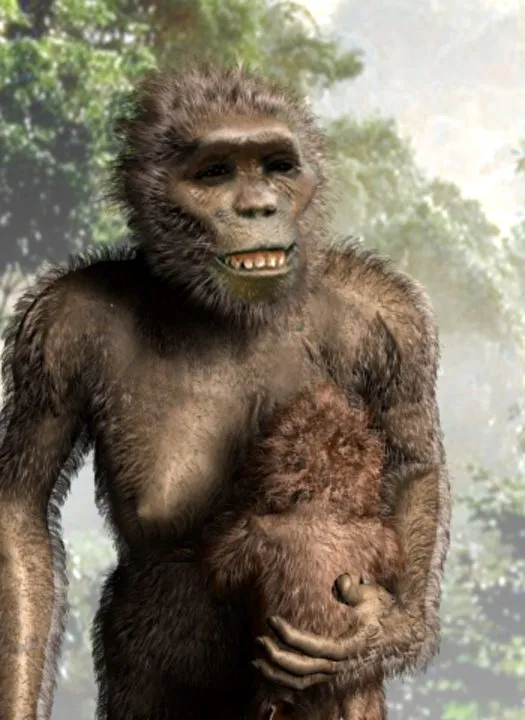
No. Lucy was an Australopithecus afarensis, a species that lived before the genus Homo appeared. She walked upright, but her brain was about the size of a chimpanzee's and her long arms were still suited to climbing.
Where was Lucy found?
Lucy was found on 24 November 1974 at Hadar, in the Afar region of Ethiopia, by Donald Johanson and Tom Gray. The skeleton is catalogued as AL 288-1 and is about 3.2 million years old.
How tall was Australopithecus afarensis?
Small by our standards. Females averaged about 105 cm (3 ft 5 in) and 29 kg, males about 151 cm (4 ft 11 in) and 42 kg. Lucy herself stood about 1.1 m tall.
Why is it called afarensis?
The name means 'from Afar', after the Afar region of Ethiopia where Lucy and hundreds of other fossils were found. Oddly, the fossil chosen as the official name-bearer, a lower jaw called LH 4, comes from Laetoli in Tanzania.
Where can I see Lucy?
The original bones are kept in a secure vault at the National Museum of Ethiopia in Addis Ababa, which displays a cast. Casts are also shown in many museums worldwide. The real skeleton has left Ethiopia only twice: a US tour from 2007 to 2013 and an exhibition in Prague in 2025.
The species in brief
Australopithecus afarensis is one of the best understood of all early human relatives. Fossils from more than 300 individuals have been found, which is far more than for most species that lived this long ago. It survived for roughly 900,000 years, longer than our own species has existed so far.
It was not a human, and it was not an ape like a chimpanzee either. It stood and walked on two legs, the way we do, but it had a small brain, a jutting face, and long, strong arms. Many researchers think it, or something close to it, was an ancestor of later humans, including the genus Homo. That is still debated.
Lucy
On the morning of 24 November 1974, Donald Johanson and his student Tom Gray were searching a gully at Hadar, in the Afar region of Ethiopia, when Johanson spotted a piece of arm bone on the slope. Around it they found more: pieces of the skull, jaw, ribs, spine, pelvis and legs, all from one small adult. That night the team played the Beatles song “Lucy in the Sky with Diamonds” in camp, and the skeleton got its nickname.
Lucy is catalogued as AL 288-1. Volcanic ash layers around the find are dated to about 3.2 million years ago. About 40 percent of her skeleton survived, which was remarkable for a fossil that old. In Ethiopia she is also known as Dinkinesh, Amharic for “you are marvellous”.
Lucy mattered because she showed, in one individual, that upright walking came long before a big brain. Before her, many people expected the brain to have grown first.
Walking upright, and still climbing
Several lines of evidence show that afarensis walked on two legs:
- The pelvis and knee. Lucy’s hip bones are short and wide, like ours, and the knee joint angles the thigh bone inward, which keeps the feet under the body when walking.
- The Laetoli footprints. At Laetoli in Tanzania, Mary Leakey’s team found footprints pressed into wet volcanic ash about 3.6 to 3.7 million years ago. Andrew Hill spotted the first prints in 1976 and the hominin trail was dug out by 1978. The prints show a heel strike, an arch, and a big toe in line with the others, much like a modern footprint. More prints of the same age turned up nearby in 2015.
The upper body tells a different story. The arms are long for the body, the fingers are curved, and the shoulder joint points upward more than ours does. Most researchers read this as a sign that afarensis still spent time in trees, perhaps to feed or to sleep safely at night. How much time is one of the long-running arguments in the field.
Body and brain
- Size. Males averaged about 151 cm (4 ft 11 in) and 42 kg. Females averaged about 105 cm (3 ft 5 in) and 29 kg. That gap between the sexes is larger than in modern humans.
- Brain. Usually under 500 cubic centimetres, about a third of a modern human brain.
- Face and teeth. A flat nose and a lower face that juts forward. The canine teeth were small compared with an ape’s, but the cheek teeth were large.
- Growing up. Children seem to have grown quickly, closer to a chimpanzee’s pace than to ours.
Food and habitat
Afarensis ate mostly plants: fruit, leaves, seeds, roots and nuts, plus insects and the odd small animal such as a lizard. Wear on the teeth suggests a lot of soft fruit, while the thick enamel and big molars hint that it could fall back on harder foods when fruit was scarce.
It did not live on open grassland, as was once assumed. The Hadar fossils come from a mix of woodland, bush and grassland near rivers and lakes, which fits an animal that both walked and climbed.
Key fossils
- Lucy (AL 288-1). Hadar, Ethiopia, about 3.2 million years old. About 40 percent of one adult female skeleton.
- The “First Family” (AL 333). Hadar, found in 1975. More than 200 fossil pieces from at least 13 individuals, adults and children, found together on one hillside.
- Selam (DIK-1-1). Dikika, Ethiopia, about 3.3 million years old. The skeleton of a child of about three, found by Zeresenay Alemseged in 2000 and announced in 2006. Selam means “peace” in Amharic. It is one of the most complete early hominin skeletons ever found.
- AL 444-2. Hadar. The most complete adult skull of the species, published in 1994.
- LH 4. Laetoli, Tanzania. A lower jaw found by Mary Leakey’s team in 1974, chosen as the official name-bearing specimen of the species.
- The Laetoli footprints. Laetoli, Tanzania, about 3.6 to 3.7 million years old. The oldest known trackway of upright walking.
How it got its name
Johanson, Tim White and Yves Coppens named the species in 1978, after Lucy and the other Hadar fossils and after the Laetoli finds made by Mary Leakey’s team. The name means “from Afar”. Because the Laetoli jaw LH 4 was chosen as the name-bearing fossil, the type specimen of a species named after Ethiopia actually comes from Tanzania. Not everyone agreed at first that the Hadar and Laetoli fossils were one species, but today most researchers accept it.
Where it fits in the family tree
Afarensis appears to follow on from an older species, Australopithecus anamensis, in the same part of Africa. It may in turn be ancestral to later australopiths, to the robust Paranthropus species, or to Homo. Which of these is right, if any, depends on fossils from between 3 and 2 million years ago, a period that is still patchy.
Where to see Lucy
The original bones are kept in a secure vault at the National Museum of Ethiopia in Addis Ababa, which displays a cast. Lucy has left Ethiopia only twice: for a tour of US museums from 2007 to 2013, and for a two-month exhibition at the National Museum in Prague in 2025, her first time in Europe, shown alongside Selam. Casts of the skeleton are on display in many natural history museums, including the Cleveland Museum of Natural History, where Johanson worked when he found her.
Sources
- Smithsonian National Museum of Natural History, Human Origins Program. Australopithecus afarensis.
- Johanson, D. C., White, T. D. and Coppens, Y. (1978). A new species of the genus Australopithecus (Primates: Hominidae) from the Pliocene of eastern Africa. Kirtlandia 28: 1 to 14.
- Leakey, M. D. and Hay, R. L. (1979). Pliocene footprints in the Laetolil Beds at Laetoli, northern Tanzania. Nature 278: 317 to 323.
- Alemseged, Z. and others (2006). A juvenile early hominin skeleton from Dikika, Ethiopia. Nature 443: 296 to 301.
- Radio Prague International (2025). Prague to host first-ever European display of Lucy.
Cite this page
Bonelore. "Australopithecus afarensis." https://bonelore.com/species/australopithecus-afarensis/