Top questions
Why is it called Nutcracker Man?
Because of its huge molars, thick jaw and the muscle attachments on its skull, which suggested it cracked hard nuts and seeds. The nickname turns out to be misleading. Tooth wear and chemical studies show it ate mostly grasses and sedges, and the wear on its teeth looks more like soft food than hard shells.
Was Paranthropus boisei a human ancestor?
Almost certainly not. It is a side branch of the family tree with no known descendants. It lived alongside early members of our own genus, Homo, for about a million years, and then died out.
What does Zinjanthropus mean?
Zinjanthropus boisei, 'East Africa man' (Zinj is an old Arabic name for East Africa), was the name Louis Leakey gave in 1959 to the skull Mary Leakey found at Olduvai Gorge. It was later moved into the genus Paranthropus and the species name boisei was kept, honouring Charles Boise, who funded the Leakeys' work.
How big was Paranthropus boisei?
Fairly small. Males probably stood about 1.3 to 1.4 metres (4 ft 3 in to 4 ft 7 in) and weighed around 40 to 50 kilograms, females somewhat less. The brain was about 400 to 550 cubic centimetres.
How is it different from Paranthropus robustus?
P. boisei lived in East Africa and was the more extreme of the two, with the biggest cheek teeth and the flattest, widest face. P. robustus lived in South Africa and was smaller-toothed and less extreme.
The species in brief
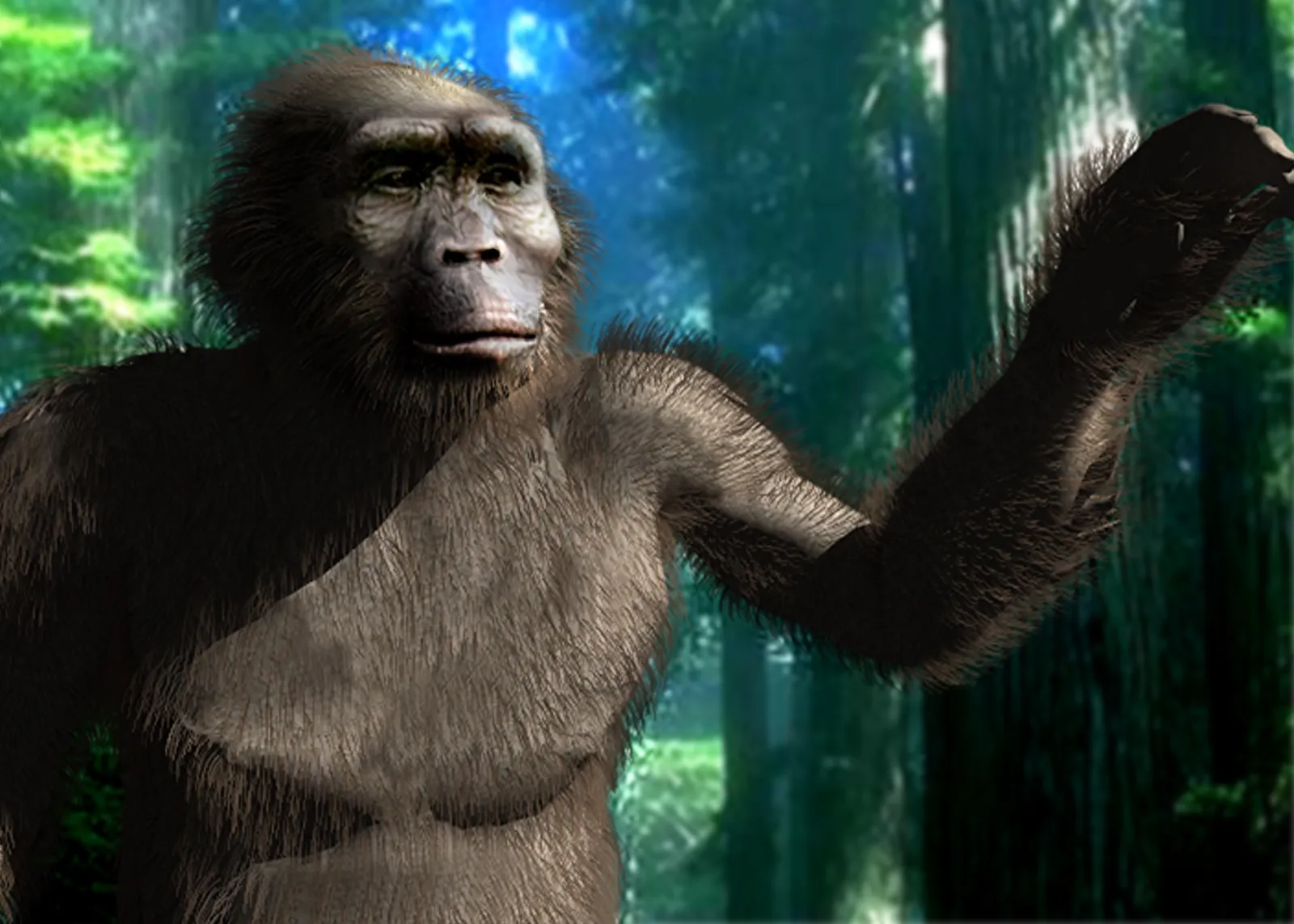
Paranthropus boisei is the best known of the “robust” australopiths, a group of early human relatives with massive jaws and chewing teeth. It lived in East Africa from about 2.3 to 1.2 million years ago, a span of more than a million years. Its fossils have been found from Ethiopia to Malawi.
It was not an ancestor of ours. It was a successful, specialised relative that lived alongside early Homo and then vanished, probably because its habitat or its food supply changed.
Zinj: the find that changed Olduvai
On 17 July 1959, Mary Leakey spotted pieces of a skull weathering out of a slope at Olduvai Gorge in Tanzania. Louis Leakey was in camp with a fever. She rode back and told him, and they spent the following weeks digging out and rebuilding a nearly complete skull, which is catalogued as OH 5 (Olduvai Hominid 5). It had a huge flat face, enormous molars and a sagittal crest, a bony ridge along the top of the skull that anchors big chewing muscles, as in a male gorilla.
Louis Leakey named it Zinjanthropus boisei and, because it lay among stone tools and broken animal bones, said it was the toolmaker. The skull was nicknamed “Zinj” and “Dear Boy”. The fossil made the Leakeys world famous and brought them the funding to carry on.
Two things followed. First, a new method called potassium-argon dating was applied to the volcanic layers at Olduvai, and in 1959 to 1961 it gave the skull an age of about 1.75 million years. That was far older than almost anyone had expected for a human relative, and it was one of the first times radiometric dating was used on an early human site. Second, within a few years the Leakeys found a second, more lightly built creature in the same layers, Homo habilis, and decided that it was the true toolmaker, not Zinj. Many researchers still think either, or both, may have used tools.
A face built for chewing
P. boisei is easy to recognise:
- Teeth. The back teeth (the premolars and molars) were enormous, several times the size of ours, and covered with thick enamel. The front teeth, by contrast, were small.
- Jaws and face. A deep, heavy lower jaw; a wide, flat, dished face with flaring cheekbones where powerful chewing muscles ran back to the skull.
- Skull. A sagittal crest, especially on males, and a small braincase of roughly 400 to 550 cubic centimetres. KNM-ER 406, a nearly complete adult skull from Koobi Fora, has a brain of about 510.
- Body. Probably about 1.2 to 1.4 m (4 ft to 4 ft 7 in) tall, with males clearly bigger than females. Few bones of the body below the head have been found, so this is the weakest part of the picture. It walked upright on two legs.
What did it eat?
The nickname “Nutcracker Man” fits the skull, but the diet does not. Two kinds of evidence changed the story:
- Tooth wear. Microscopic scratches and pits on the chewing surfaces of P. boisei teeth look more like those of animals that eat soft or tough, not hard, foods. A 2008 study found no sign of hard-shell cracking.
- Carbon isotopes. In 2011 a team led by Thure Cerling measured carbon in the enamel of 22 individuals. It showed that on average about 77 percent of the carbon came from plants of the grass and sedge type (called C4 plants), more than in any other early human relative studied. P. boisei seems to have eaten large amounts of grasses, sedges, or their roots and stems. In that respect it resembles grazing animals such as warthogs and zebras more than it does a human.
Why it needed such huge teeth to eat grass is still a puzzle. One idea is that it handled large amounts of low-quality plant food with brute chewing power. Another is that the teeth were built for the hard foods it could fall back on in lean seasons.
Where it lived
Fossils are known from the Omo valley and Konso in Ethiopia; Koobi Fora and West Turkana, and Chesowanja in Kenya; Olduvai Gorge and Peninj in Tanzania; and Malema in Malawi. Pollen and animal remains suggest it favoured wet, open places such as lake margins, river floodplains and marshes, where sedges and grasses grow.
At Koobi Fora it shared the same landscape with Homo erectus and early Homo. In 2024 a team led by Kevin Hatala described a surface at Koobi Fora that preserves footprints of two different two-legged creatures walking across the same patch of lakeshore, about 1.5 million years ago. They attributed the more robust-looking prints to P. boisei and the others to Homo erectus. These are the first footprints linked to Paranthropus, and they show that the two species were present in the same place at the same time.
Where it fits in the family tree
Paranthropus boisei is one of three species usually placed in the genus Paranthropus. The others are Paranthropus aethiopicus, an older and more primitive East African form, and Paranthropus robustus of South Africa. Many researchers think aethiopicus gave rise to boisei, that all three form a single branch descended from an earlier Australopithecus, and that the branch ended without descendants. A minority argue that the “robust” features evolved separately in East and South Africa, in which case the genus would need to be split. This is one of the standing disagreements in the field.
Where to see it
The original OH 5 skull belongs to the National Museum of Tanzania in Dar es Salaam, and casts are shown in many museums. KNM-ER 406 and other Koobi Fora fossils are held by the National Museum of Kenya in Nairobi. The Olduvai Gorge site has a small museum near where Zinj was found.
Sources
- Smithsonian National Museum of Natural History, Human Origins Program. Paranthropus boisei.
- Leakey, L. S. B. (1959). A new fossil skull from Olduvai. Nature 184: 491 to 493.
- Cerling, T. E. and others (2011). Diet of Paranthropus boisei in the early Pleistocene of East Africa. Proceedings of the National Academy of Sciences 108: 9337 to 9341.
- Ungar, P. S., Grine, F. E. and Teaford, M. F. (2008). Dental microwear and diet of the Plio-Pleistocene hominin Paranthropus boisei. PLoS ONE 3: e2044.
- Hatala, K. G. and others (2024). Footprint evidence for locomotor diversity and shared habitats among early Pleistocene hominins. Science 386: 1004 to 1010.
Cite this page
Bonelore. "Paranthropus boisei." https://bonelore.com/species/paranthropus-boisei/