Top questions
Why is it called the Black Skull?
Because of its colour. The skull, catalogued KNM-WT 17000, is stained dark blue-black by manganese minerals in the soil where it lay for about 2.5 million years. It was found by Alan Walker's team at Lomekwi, west of Lake Turkana, in 1985.
How is it different from Paranthropus boisei?
It is older and more primitive. The Black Skull has a very small braincase of about 410 cubic centimetres, a face that juts forward more, a huge sagittal crest set far back, and a flatter base to the skull. Paranthropus boisei, which came later, had a rounder braincase and an even more massive set of cheek teeth.
Was Paranthropus aethiopicus an ancestor of boisei?
Many researchers think so. The Black Skull looks like an early stage of the boisei design, and the two lived in the same part of East Africa one after the other. Others argue that the robust features evolved separately, and that aethiopicus and boisei are only cousins.
Where was it first found?
In the Omo valley of southern Ethiopia, in 1967, where a lower jaw was found by a French team led by Camille Arambourg and Yves Coppens. They named it in 1968. The jaw is about 2.6 million years old.
How many fossils are known?
Very few: the Black Skull, a few jaws and teeth from the Omo valley and a handful of other bits from West Turkana. The species is one of the least known early human relatives, so much of what is said about it rests on one skull.
The species in brief
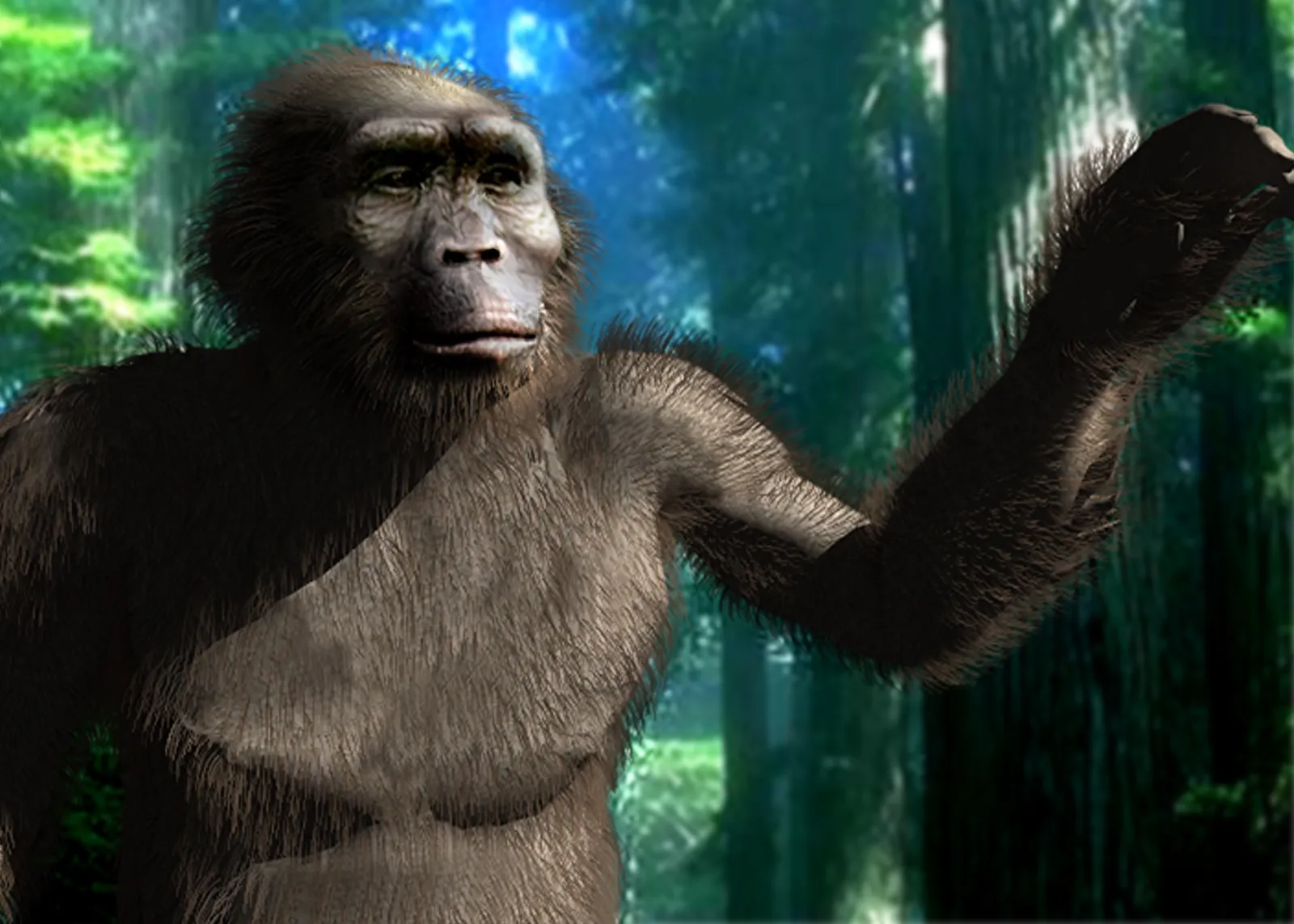
Paranthropus aethiopicus is the oldest of the “robust” australopiths, the group of early human relatives built for heavy chewing. It lived in East Africa from about 2.7 to 2.3 million years ago, a time when the climate was drying and open grasslands were spreading. It is known from only a few fossils, and most of what we know comes from one dramatic skull.
The Omo jaw
In the 1960s an international team led by the French geologist Camille Arambourg, and later by Yves Coppens, worked in the Shungura Formation of the Omo valley in southern Ethiopia, a long sequence of river and lake layers with fossils of many animals. In 1967 they found a lower jaw with teeth, which was catalogued Omo 18. The jaw was large, with a robust shape and very large molars.
Arambourg and Coppens named it in 1968, calling it Paraustralopithecus aethiopicus, and thought it was a new type of australopith. It was later moved into the genus Paranthropus, and the species name aethiopicus, “from Ethiopia”, was kept. For years the jaw was thought too incomplete to say much.
The Black Skull
In August 1985 Alan Walker, working with Richard Leakey’s expedition, found a piece of skull at Lomekwi, west of Lake Turkana in Kenya, and the team soon found more. The skull was reconstructed from the fragments and catalogued as KNM-WT 17000. The soil there is rich in manganese, which had stained the bones a dark blue-black, giving the skull the nickname “the Black Skull”.
Walker, Leakey, Harris and Brown reported the skull in Nature in 1986 as a very early boisei (at that time called Australopithecus boisei), dated to about 2.5 million years ago. Other researchers soon argued that it matched the older Omo jaw, and it is now generally placed in Paranthropus aethiopicus.
The skull is a striking mix:
- Huge crest. A tall sagittal crest on the top of the skull, joined at the back by another ridge, for anchoring very strong chewing muscles.
- Flat face with a jutting muzzle. The face is dished, as in P. boisei, but the lower face thrusts forward more than in later robust species, as in older australopiths.
- Small brain. About 410 cubic centimetres, one of the smallest of any australopith.
- Big back teeth. The teeth that came with it are broad and thick-enamelled.
Where it fits in the family tree
The Black Skull is important in a long-running argument. When it was found, it appeared to link the robust species back to older, more primitive East African species, and especially to Australopithecus afarensis. It also looks like the ancestor of Paranthropus boisei: a skull that is similar to boisei but with older features. In that case the chain would run from afarensis to aethiopicus to boisei, and Paranthropus robustus in South Africa would have come from the same line.
The major objection is that the robust features, such as the crest, wide face and large cheek teeth, might have evolved more than once, in different lines of australopiths in response to the same food pressures. If so, aethiopicus and boisei might be cousins, and the genus would be split up. Better and more complete fossils from between 3 and 2 million years ago are needed to settle this.
Where to see it
KNM-WT 17000 belongs to the National Museums of Kenya in Nairobi. The Omo fossils are held in Ethiopia’s National Museum in Addis Ababa. Lomekwi, the site of the Black Skull, is near the Koobi Fora area on Lake Turkana.
Sources
- Smithsonian National Museum of Natural History, Human Origins Program. Paranthropus aethiopicus.
- Arambourg, C. and Coppens, Y. (1968). Découverte d’un Australopithécien nouveau dans les gisements de l’Omo (Éthiopie). South African Journal of Science 64: 58 to 59.
- Walker, A., Leakey, R. E., Harris, J. M. and Brown, F. H. (1986). 2.5-Myr Australopithecus boisei from west of Lake Turkana, Kenya. Nature 322: 517 to 522.
Cite this page
Bonelore. "Paranthropus aethiopicus." https://bonelore.com/species/paranthropus-aethiopicus/