Top questions
Who found the first Paranthropus robustus?
A schoolboy named Gert Terblanche found a fossil jaw fragment with teeth at Kromdraai, near Johannesburg, in 1938 and gave it to Robert Broom, the Scottish paleontologist, who bought more from the site, found the rest of the skull, and named it Paranthropus robustus, 'sturdy near-man'. It started the genus Paranthropus.
What did Paranthropus robustus eat?
A varied diet. Its big back teeth were built for heavy chewing, and tooth chemistry shows a mix of forest plants and grassland foods, probably seeds, roots, tubers and some animal food. The diet seems to have varied with the season and the place, and was less exclusively grass than that of Paranthropus boisei.
Did Paranthropus robustus use tools?
Possibly. At Swartkrans dozens of polished bone fragments seem to have been used for digging, possibly into termite mounds. Some researchers think Homo made them, and others point to Paranthropus. The hand bones of Paranthropus show it could have gripped small objects.
How is it different from Paranthropus boisei?
Paranthropus robustus lived in South Africa and boisei in East Africa. Robustus was smaller and less extreme: smaller cheek teeth, a lower sagittal crest and a less flaring face. They are close relatives, and most researchers think they share a common ancestor.
Did Paranthropus robustus live with Homo?
Yes. At Swartkrans, Drimolen and Sterkfontein the fossils of Paranthropus robustus are found with the early members of Homo, including Homo erectus. Both made their living in the same area for a long time, but they probably ate different things.
The species in brief
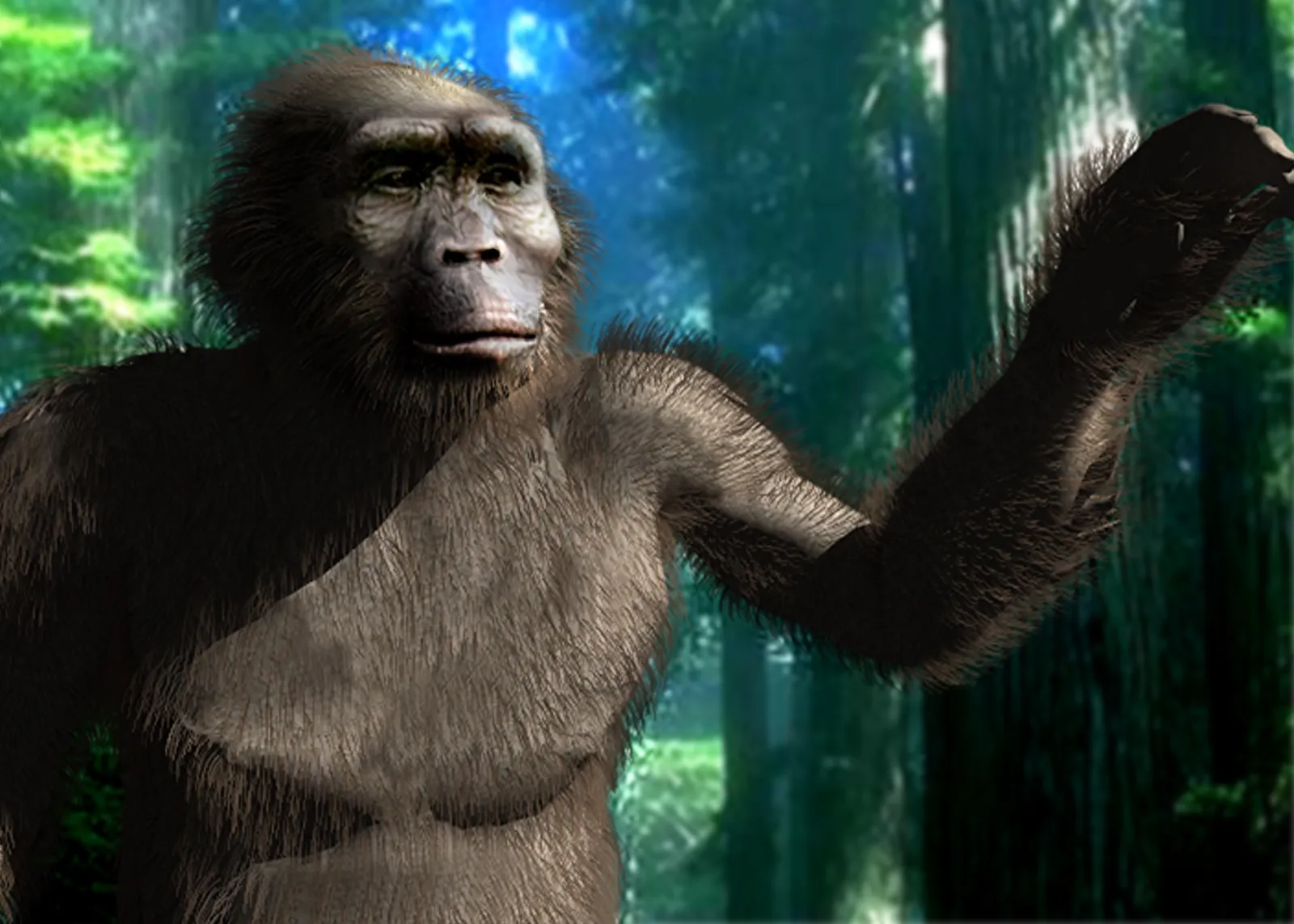
Paranthropus robustus is the southern cousin of Paranthropus boisei. It lived in the grassy, wooded hills of what is now Gauteng province, South Africa, from about 2 to 1.2 million years ago. Males were about 1.2 m (4 ft) tall and weighed about 40 kg, females less. The brain was about 530 cubic centimetres, small for a creature that lived alongside early Homo.
It was a robust australopith, with big cheek teeth, thick jaws and a skull built to carry strong chewing muscles. It is also the species that gave the genus its name: Paranthropus means “beside man”.
Discovery
In 1938 Gert Terblanche, a schoolboy, found a piece of jaw with teeth at Kromdraai, a farm near Sterkfontein, and gave it to Robert Broom. Broom was a Scottish doctor and paleontologist who had been looking for fossils in the caves near Johannesburg since the 1930s. Visiting the boy, Broom discovered the rest of the skull’s bones at the site. He saw that the large teeth and strong jaw were different from the Australopithecus africanus he had been finding at Sterkfontein, and he named a new genus, Paranthropus, and species robustus in 1938.
In 1948 Broom and his assistant John Robinson began to dig at nearby Swartkrans, where they found many more fossils. Swartkrans became the main source of P. robustus fossils, with more than a hundred individuals, along with fossils of early Homo. More came from Drimolen, where an almost complete skull of a female (DNH 7) nicknamed “Eurydice” was found in 2000.
Anatomy
- Teeth. Large premolars and molars, set in a deep jaw, with thick enamel. The front teeth were small.
- Skull. A face that is broad and flat, with prominent cheekbones for the chewing muscles, and in males a ridge along the top of the skull (the sagittal crest).
- Brain. About 530 cubic centimetres.
- Hands and feet. The hand bones show a thumb that could press against the fingers, so the hand could grip precisely. The foot was adapted to walking upright, as in all australopiths.
- Growth. The teeth of young individuals from Swartkrans show they grew up faster than modern humans.
Food, fire and tools
The wear and the chemistry of the teeth show that P. robustus ate a wide range of foods, which fits its life in a changing landscape: forest and shrub plants, grassland plants, roots and tubers dug from the ground, with signs in the enamel that the mix changed from season to season. Among the fossils at Swartkrans researchers found dozens of bone fragments polished at one end, the tips worn in a way that matches experimental digging into termite mounds. Whether they were made by Paranthropus or by early Homo is unknown, and probably both used them.
The same cave has burnt bones that were dated to about 1.0 to 1.5 million years ago. C. K. Brain, who excavated Swartkrans, thought they were evidence for early fire use. Later studies suggested that some of the burning might have been natural. The topic is open, and who tended the fires, if anyone did, remains unknown.
Not all of them died peacefully. Some of the Swartkrans individuals were killed by leopards. The skull of a young individual, SK 54, has two puncture holes spaced like a leopard’s lower canines, and the cave may have been a leopard’s feeding place.
Where it fits in the family tree
P. robustus is generally placed in a small branch with P. boisei and the older P. aethiopicus. How they relate is debated. They may all descend from a single ancestor, in which case the branch began in East Africa and one population spread south. Or similar features may have evolved twice, in East and South Africa, from different australopiths. P. robustus had no known descendants. It disappeared about 1.2 million years ago, while Homo continued.
Where to see the sites
The Sterkfontein Caves, Swartkrans, Kromdraai and Drimolen are all in the Cradle of Humankind World Heritage Site near Johannesburg. See the Sterkfontein page. Sterkfontein and the Maropeng visitor centre are open to the public. The fossils are kept at the Ditsong National Museum of Natural History in Pretoria and the University of the Witwatersrand.
Sources
- Smithsonian National Museum of Natural History, Human Origins Program. Paranthropus robustus.
- Broom, R. (1938). The Pleistocene anthropoid apes of South Africa. Nature 142: 377 to 379.
- Brain, C. K. (1981). The Hunters or the Hunted? An Introduction to African Cave Taphonomy. University of Chicago Press.
- Backwell, L. R. and d’Errico, F. (2001). Evidence of termite foraging by Swartkrans early hominids. Proceedings of the National Academy of Sciences 98: 1358 to 1363.
- Herries, A. I. R. and others (2020). Contemporaneity of Australopithecus, Paranthropus, and early Homo erectus in South Africa. Science 368: eaaw7293.
Cite this page
Bonelore. "Paranthropus robustus." https://bonelore.com/species/paranthropus-robustus/